Ostrich in Namibia
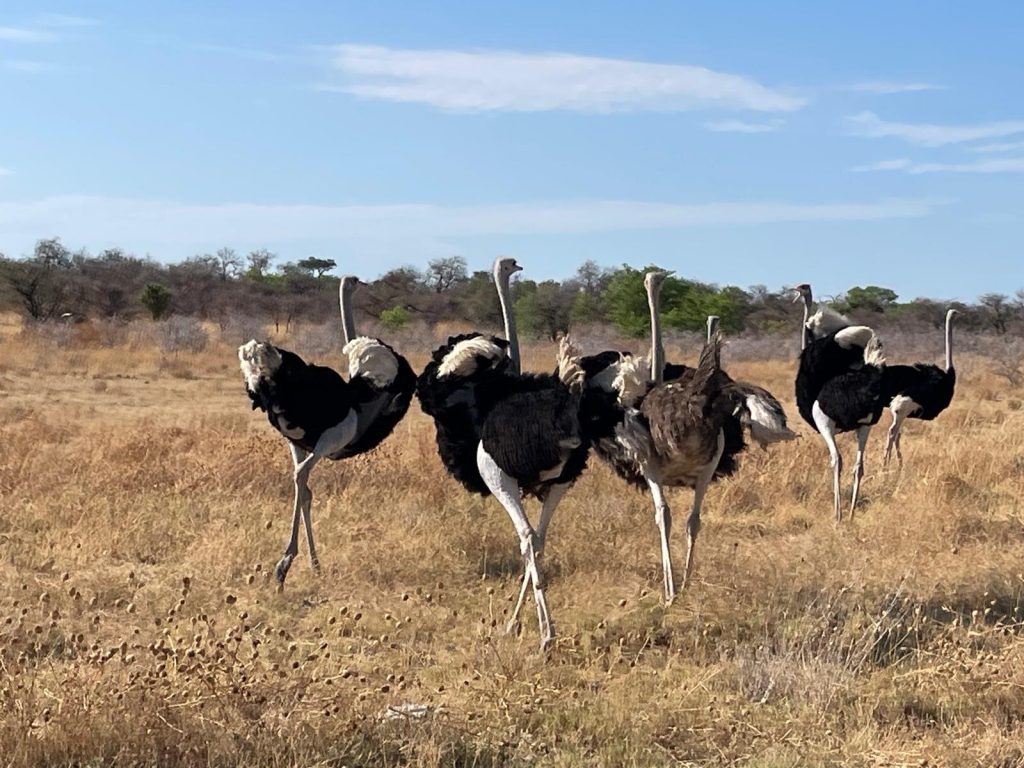
Ostriches are the largest and heaviest birds on earth, reaching 2.8 metres and up to 150 kilograms, and they roam wild across Etosha, the Namib gravel plains and most of the open country between. They sprint at up to 70 kilometres an hour and a cornered bird can kill a lion. The ones you see in Namibia are wild rather than farmed.
Wild Ostrich in Namibia
This is worth stating first because ostrich farming is widespread in southern Africa and many visitors assume every bird they see is escaped stock.
Namibia holds genuinely wild common ostrich, Struthio camelus, across its open country. They occur throughout Etosha, on the Namib gravel plains inland of the coast, across the Kalahari in the east and on farmland in between. Arid open country with long sightlines is exactly what they want.
The common ostrich is listed as least concern, helped by an enormous range covering close to ten million square kilometres. That masks a substantial decline over the past two centuries driven by the plume trade, hunting and habitat loss.
Other ostrich populations have fared far worse. The North African subspecies is critically endangered, the Somali ostrich is vulnerable, and the Arabian ostrich is extinct. Namibia’s birds belong to a form that survived the feather boom, which was as consequential for ostriches as ivory was for elephants.
Telling Males from Females
Ostriches are one of the easier birds in Namibia to sex, and the difference is visible from a long way off.
Males are black with white wing and tail plumes, and the black deepens as they mature. Females and immature birds are a uniform sandy grey brown, which is far better camouflage on open ground.
That difference is not decorative. Females sit on the nest during the day, where dull colouring blends into the gravel and grass, while males take the night shift, where black is close to invisible. It is one of the neater examples of a shared task splitting the plumage between the sexes.
Both sexes have long necks, long legs and the enormous eyes with heavy lashes that give the bird its slightly startled expression. They have the largest eyes of any land animal.
Built for Running
Ostriches cannot fly. They lack the strong anchored pectoral muscles that lifting a body of this size would need, and in any case the wings serve other purposes.
What they can do is run. Sustained speeds of around 50 kilometres an hour and short sprints reaching 70 make them the fastest bird on land and among the fastest animals in Namibia over distance. A single stride can cover several metres.
Two toes rather than the usual bird arrangement of three or four is part of the reason. Reducing the number of toes and enlarging the main one gives a more efficient stride, in the same way that a horse’s single hoof does. Ostriches are the only birds with two toes.
The wings act as rudders and brakes, spread for balance during sharp turns at speed. They are also used in display, spread and shaken by males during courtship and in threat.
An ostrich walking with wings half spread and drooping is not relaxed. That is a threat or a display posture, and if the bird is between you and a nest it may commit. Ostriches kick forward with enough force to kill, and the claw on the main toe does the damage. Stay in the vehicle, do not walk towards one on foot, and give any bird with chicks a wide berth.
The Head in the Sand Myth
Ostriches do not bury their heads in the sand, and the belief is worth dismantling because it comes from something they genuinely do.
When a sitting bird detects danger at distance, it flattens its neck and head along the ground rather than standing up. At a distance, with heat shimmer over open ground, the body looks like a mound and the head disappears entirely, which is presumably how the story started.
They also turn eggs with the beak, putting the head down into the nest scrape, which produces the same impression to a distant observer.
What they actually do when threatened is either lie flat, run, or fight, and which one depends on distance and whether there is a nest to defend. A bird with eggs is far more likely to stand its ground.
Breeding and the Communal Nest
Ostrich breeding involves an arrangement that is genuinely unusual among birds.
A dominant male establishes a territory and a scrape, and a major hen lays in it. Several minor hens then lay in the same nest, which can end up holding a very large number of eggs, more than the pair could possibly cover.
The major hen sorts them. She recognises her own eggs and moves them to the centre of the clutch where incubation is most reliable, pushing the others to the edges where they are likelier to fail or be taken. The minor hens gain a chance at reproduction and provide, in effect, a buffer of expendable eggs around the ones that matter.
Incubation is shared, with the drab female sitting by day and the black male by night. Ostrich eggs are the largest laid by any living bird, though relative to the adult they are among the smallest.
Chicks are mobile almost immediately and creches form, with one or two adults escorting large groups of young from several nests. Seeing an adult pair with thirty or forty chicks is common in Etosha, and most of them are not their own.
What Ostriches Eat and How They Cope With Drought
Ostriches are omnivores and take a wide range: grasses, seeds, leaves, flowers, roots, along with lizards, snakes, rodents and insects.
Most of their water comes from what they eat, which is why they persist in country with no surface water for long stretches. They will drink readily where water exists and they can go without it for extended periods.
They swallow stones deliberately, which sit in the gizzard and grind tough plant material, an arrangement common in birds but taken to considerable scale in an animal this size.
Their tolerance of heat is high. Like several Namibian species they allow body temperature to rise rather than spending water on cooling, and they use the bare skin of the neck and legs to shed heat.
Where to See Ostrich in Namibia
Etosha. Common throughout the open plains and pan edges, often with large creches of chicks in the months after the rains. The easiest place to see them well.
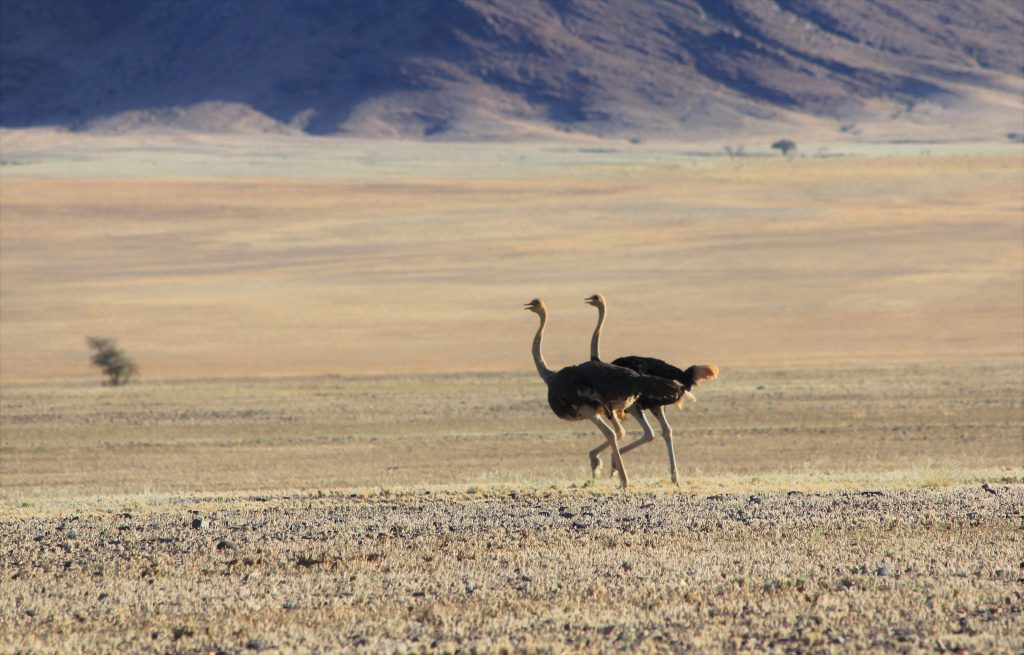
Namib gravel plains. Inland of Swakopmund and on the drive towards Sandwich Harbour, in country that looks empty of everything. Often alongside oryx and springbok.
The Kalahari. Red dune country in the east, where the interdune valleys and grass suit them well.
Sossusvlei area. Along the dune road and on the gravel between Sesriem and Solitaire, occasionally against a backdrop of red dunes.
Best Time to See Ostrich
Any month. Ostriches are present year round throughout their range and do not concentrate seasonally.
The months after the rains, roughly February to May, are the most interesting because that is when chicks appear and creches form. An adult pair leading forty striped chicks across an Etosha plain is worth stopping for.
Time of day matters little for finding them, since they are diurnal and conspicuous. Early and late light suits photography, particularly against pale ground where a black male stands out.
Ostrich in Namibia Questions
Do ostriches bury their heads in the sand?
No. When a sitting bird detects danger at distance it flattens its neck and head along the ground, which at a distance through heat shimmer makes the head appear to vanish. They also put the head into the nest scrape to turn eggs, which looks similar. Faced with a real threat they lie flat, run, or fight, and a bird with eggs is much more likely to stand its ground.
How fast can an ostrich run?
Around 50 kilometres an hour sustained, with short sprints reaching 70, which makes them the fastest bird on land. A single stride covers several metres. Part of the reason is that they are the only birds with two toes rather than three or four, an arrangement that gives a more efficient stride in the same way a horse’s single hoof does.
Are ostriches dangerous?
They can be. An ostrich kicks forward with enough force to kill, and the claw on the main toe does the damage. A cornered bird is genuinely capable of killing a lion. They will not seek out a person, but a bird defending a nest or chicks may commit. Stay in your vehicle, never walk towards one, and treat a bird with half spread drooping wings as displaying rather than relaxed.
How do I tell male from female ostrich?
Males are black with white wing and tail plumes; females and young birds are uniform sandy grey brown. The difference relates to nest duty: the drab female sits by day where dull colouring blends into gravel and grass, and the black male sits at night where he is close to invisible. It is one of the clearest examples of plumage split by task rather than by display alone.
Why do you see so many chicks with one pair?
Because ostriches use communal nests and creches. Several minor hens lay in a dominant female’s nest, and the major hen moves her own eggs to the centre of the clutch where incubation works best, leaving the others at the edges. After hatching, one or two adults escort large groups of chicks from several nests, so a pair with thirty or forty young is normal and most are not theirs.
Are ostriches in Namibia wild or farmed?
Wild. Ostrich farming is widespread in southern Africa and many visitors assume the birds they see have escaped, but Namibia holds genuinely wild common ostrich across Etosha, the Namib gravel plains, the Kalahari and open farmland in between. The species is listed as least concern globally, helped by an enormous range, though numbers fell substantially during the plume trade era.
Do ostriches need to drink?
Not regularly. They take most of their water from what they eat, which includes grasses, seeds, leaves, roots, lizards, snakes, rodents and insects. They drink readily where water is available and can go long periods without it. Like several Namibian species they let body temperature rise rather than spending water on cooling, and shed heat through bare skin on the neck and legs.
Booking Your Namibia Trip
The safari companies and tour operators listed on this website put trips like this together for a living and know which camps, guides and routes actually deliver. We are an independent guide to Namibia; we do not book or sell tours ourselves.
When you are ready, arrange your safari, tour or holiday with one of the recognised operators listed here. Tell them your dates and what matters most, and a real person, not a form, will handle the itinerary, park bookings and logistics for you.