Epupa Falls
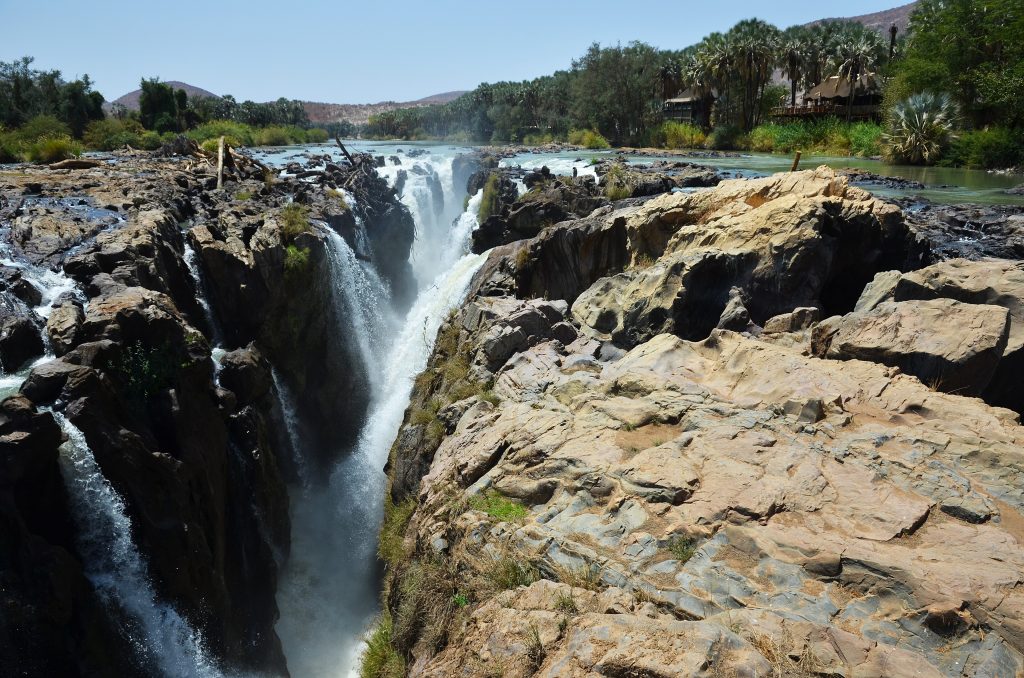
Epupa Falls is a series of cascades where the Kunene River drops through a rocky gorge on the Angolan border, spread across a stretch roughly a kilometre and a half wide with the main drop around 37 metres. It sits 180 kilometres north of Opuwo in Kaokoland. Makalani palms and baobabs line the banks, and after days of dust the sound of running water is the shock.
What Epupa Actually Looks Like
Epupa is not one waterfall and visitors expecting a single sheet of water are often surprised by what they find.
The Kunene arrives at a band of harder rock and splits into a number of channels, dropping through them into a gorge across a front around a kilometre and a half wide. The main drop is usually given as around 37 metres, with individual channels varying and the total descent through the area running higher.
What makes it work visually is the setting rather than the height. Makalani palms line the banks in numbers, baobabs stand among the rocks, and the water throws spray into the air that catches rainbows through much of the day.
The name is said to derive from a Herero word describing foam, which is what the falling water produces in quantity.
Angola is on the far bank. The Kunene forms the border here, so you are looking at another country across the water, which adds something to the experience that photographs do not convey.
The Green That Nobody Expects
The single most striking thing about Epupa is the contrast with everything around it.
Getting here means driving through Kaokoland, some of the driest and most austere country in Namibia, where water is a genuine planning problem and the terrain is rock and gravel. Then the road drops to the river and there are palms, running water, shade and noise.
Local families wash and swim in pools along the bank, and strings of drying clothes hang between the palms. The area supports crops in a way nothing for a hundred kilometres in any direction does.
For many visitors the arrival is the memorable part rather than the falls themselves, and it is worth arriving with that in mind.
Do not swim in the main river. Crocodiles are present in the Kunene and this is not a theoretical concern. Local people swim in specific shallow pools they know, which is not the same as a visitor picking a spot that looks safe. If you want to get in the water, ask at your camp which pools are used and follow that advice exactly.
Viewpoints and Walking
The falls are viewed from several points and it is worth doing more than one.
The most rewarding is the walk up to the viewpoint on the ridge above the falls, which takes twenty minutes to half an hour depending on which route you take. From up there the whole system opens out: the river arriving, the channels splitting, the gorge below and Angola beyond, with baobabs on the slope around you.
Sunset from that ridge is the reason a good many people come, and it is the single best hour at Epupa. The light comes across the water and the palms, and the spray catches it.
Lower down, paths run along the bank to points where you stand close to individual channels. There are no railings and the rock is wet and slippery near the water, so take that seriously.
Guides at the camps take walks to the viewpoints and to the baobabs, and the local knowledge is worth having.
Seasonal Flow
How much water is coming over makes a considerable difference and it is worth timing around.
The Kunene rises in Angola and its flow depends on rainfall there rather than in Namibia. The river runs year round, so Epupa always has water, but the volume swings enormously.
Peak flow follows the Angolan rains, roughly from around March to May, when the falls are at their most powerful and the spray at its heaviest. In the dry months from about August to November the flow drops and the rock structure of the falls becomes more visible, which some photographers prefer.
Both versions are worth seeing and neither is a wasted trip. High water gives power and rainbows; low water gives shape and access to viewpoints closer to the channels.
Ruacana Falls and the Dam Question
Epupa’s other well known relative on the same river is worth a mention, along with a piece of history that still marks the area.
Ruacana Falls sits to the east where the Kunene enters Namibia, and it is larger in volume when it runs. The catch is that it is heavily controlled by the hydroelectric scheme upstream, so it flows properly only when the river is in flood and can be a dry cliff at other times.
Epupa itself was the subject of a long running proposal to build a hydroelectric dam that would have flooded the falls and the surrounding valley. The Himba communities of the area opposed it strongly, on the grounds that it would have submerged ancestral graves and grazing land central to their way of life.
The scheme was not built and attention shifted to alternative sites. The episode is part of why Epupa matters beyond tourism, and local guides will raise it if asked.
The Himba at Epupa
Epupa sits in Himba country and the community presence is part of what visitors come across.
Himba homesteads occupy the area and community visits are arranged through the camps, with local guides who know the families and speak the language. That is the right way to do it. Arriving at a homestead unannounced is intrusive and will not go well.
Take the standard guidance seriously. Ask before photographing and accept a refusal. Bring useful gifts bought in Opuwo, such as maize meal, sugar, cooking oil or tobacco, rather than sweets or cash, and ask your guide what is needed. Keep the visit short unless invited to stay.
The Himba way of life here has persisted more completely than almost anywhere in southern Africa, and the tourism around it can either support that or corrode it depending on how it is done.
Where to Stay at Epupa
Several camps and campsites sit along the riverbank above and beside the falls, running from basic pitches under the palms to comfortable tented rooms.
Sleeping within earshot of the water is the point of staying here. The sound carries all night and it is the opposite of everything else in Kaokoland.
Facilities are limited and the settlement has a small shop and a fuel point, both of which should be treated as a bonus rather than something to plan around. Fill up at Opuwo before heading north.
Two nights lets you do a sunset and a sunrise at the viewpoint, a Himba visit and a walk without rushing, which is about right.
Best Time to Visit Epupa Falls
May to October is the practical window for reaching Epupa at all, since the roads north from Opuwo become unreliable during the rains and dry riverbeds along the route can flash flood.
Within that, the earlier part of the window catches the tail of the high water from the Angolan rains, while later months give lower flow and clearer rock structure.
January to March brings both the highest water and the worst access, which is a genuine tension. Green season travel in Kaokoland is for experienced overlanders rather than a standard trip.
Sunset is the hour that matters on any day, from the ridge above the falls.
Getting to Epupa Falls
Epupa lies 180 kilometres north of Opuwo on the C43, which takes around three hours on gravel and is manageable in a high clearance vehicle in the dry season.
Opuwo is roughly 720 kilometres from Windhoek, tarred the whole way via Otjiwarongo, Outjo and Kamanjab, which is a long day. From Etosha’s Galton Gate the run west is shorter, and from Damaraland the route comes north through Sesfontein.
The road north from Opuwo passes Himba homesteads and baobabs hung with weaver nests before dropping to the river. Fuel and supplies come from Opuwo, and there is nothing dependable in between.
Epupa Falls Questions
How high is Epupa Falls?
The main drop is usually given as around 37 metres, though Epupa is a series of channels rather than a single fall, spread across a front roughly a kilometre and a half wide, with individual drops varying. The setting does more work than the height: makalani palms and baobabs line the banks and the spray throws rainbows through much of the day.
When is the best time to see the falls?
May to October is the practical window because the roads north from Opuwo become unreliable in the rains. Peak water follows the Angolan rains, roughly March to May, when the falls are most powerful. From August to November the flow drops and the rock structure becomes visible, which some photographers prefer. Both versions are worth the trip.
Can I swim at Epupa Falls?
Not in the main river. Crocodiles are present in the Kunene and the risk is real rather than theoretical. Local people swim in specific shallow pools they know well, which is not the same as a visitor choosing somewhere that looks safe. Ask at your camp which pools are used and follow that advice exactly.
How do I get to Epupa Falls?
180 kilometres north of Opuwo on the C43, around three hours on gravel, manageable in a high clearance vehicle in the dry season. Opuwo itself is roughly 720 kilometres from Windhoek and reachable on tar the whole way. Fuel and supplies come from Opuwo, and there is nothing dependable between there and the river.
Is Epupa in Namibia or Angola?
The falls sit on the Kunene River, which forms the border, so they are shared. You view them from the Namibian side and Angola is on the far bank. Being able to look across into another country while standing at the falls is part of what the place offers and something photographs do not convey.
What is the difference between Epupa and Ruacana?
Ruacana sits to the east where the Kunene enters Namibia and is larger in volume when it runs. The catch is that a hydroelectric scheme upstream controls it, so it flows properly only when the river is in flood and can be a dry cliff otherwise. Epupa runs year round with varying volume, which makes it the more dependable of the two.
How long should I stay at Epupa?
Two nights. That allows a sunset and a sunrise from the ridge viewpoint above the falls, a Himba community visit arranged through your camp, and a walk along the bank without rushing. One night works if you arrive by mid afternoon, given the three hour drive from Opuwo in each direction.
Booking Your Namibia Trip
The safari companies and tour operators listed on this website put trips like this together for a living and know which camps, guides and routes actually deliver. We are an independent guide to Namibia; we do not book or sell tours ourselves.
When you are ready, arrange your safari, tour or holiday with one of the recognised operators listed here. Tell them your dates and what matters most, and a real person, not a form, will handle the itinerary, park bookings and logistics for you.