Kudu in Namibia
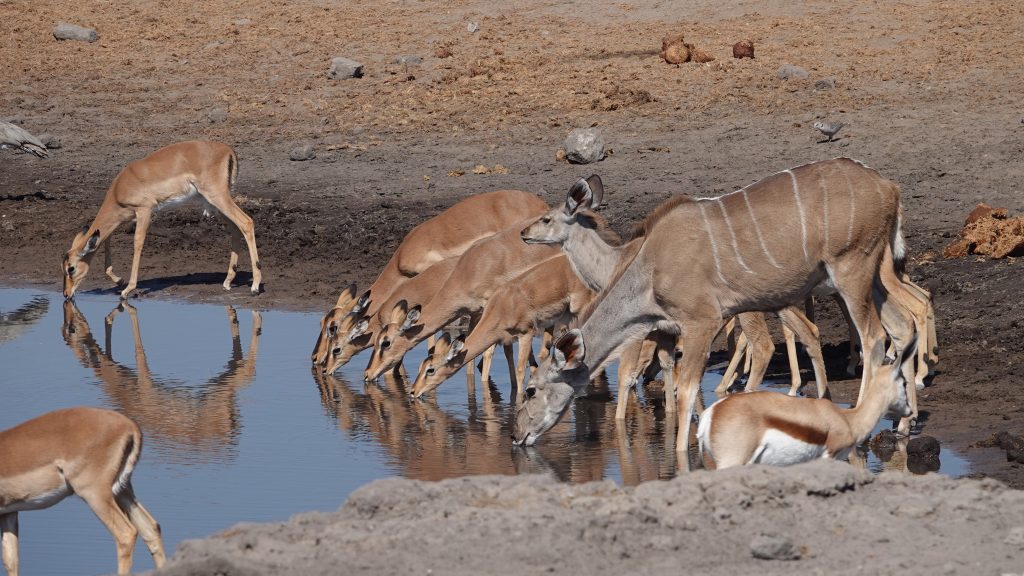
Namibia holds the highest density of greater kudu in Africa, and the country is also the only place in the species’ range where kudu suffer recurring rabies epidemics. The first outbreak killed an estimated 50,000 animals, around a fifth of the national population. Kudu are browsers of dense bush, and the spiral horned bulls are among the more striking animals you will see here.
Kudu Density in Namibia
Greater kudu, Tragelaphus strepsiceros, occur widely across eastern and southern Africa, and in most of that range they are thinly spread. Namibia is the exception, with the highest kudu density anywhere on the continent.
The reason is partly habitat and partly what is missing. Kudu favour dense bush and broken country, which much of central and northern Namibia provides. And across large parts of the central farmland where they are most abundant, lion, spotted hyena and African wild dog are absent, having been removed by farming generations ago.
Elsewhere in Africa those three predators take a substantial share of kudu. Studies from Hwange and Kruger put kudu at meaningful percentages of wild dog and spotted hyena kills. In central Namibia none of that pressure exists, and kudu numbers respond accordingly.
That abundance has consequences beyond a good sighting, as the rabies story below shows.
The Namibian Kudu Rabies Phenomenon
This is unique to Namibia and it is one of the odder things in African wildlife epidemiology.
Rabies in greater kudu occurs here at a magnitude not reported anywhere else in southern Africa, and it does not occur in this form in any other part of the species’ natural range. The first cases appeared in central Namibia near Windhoek in the early nineteen seventies, and the disease then spread north to all major kudu habitats in the country, including Etosha.
The first epidemic ran through the late seventies into the mid eighties and killed an estimated 50,000 kudu, roughly 20 percent of the total population. Some accounts put the figure higher. A second major wave began at the start of this century, with around 2,500 animals dying on more than 81 farms in one year alone, and rabies in kudu is now regarded as endemic here.
The economic damage to the game farming and hunting industry has been severe, and there is no indication the disease will abate soon.
Why Kudu Pass Rabies to Each Other
The mechanism is what makes this genuinely unusual, and it took researchers a long time to accept it.
Rabies normally spreads by bite, typically from a carnivore. Genetic work suggests the virus affecting Namibian kudu originally came from jackal. What could not be explained was how an outbreak of that scale could sustain itself through jackal bites alone.
The current view is that kudu transmit it to each other without biting. Several behaviours make that plausible. Kudu browse in groups from the same acacia trees, whose thorns cause small lesions in the mouth. Infected animals excrete high levels of virus in saliva. And kudu engage in mutual social licking within the herd.
Saliva from an infected animal on a shared branch, entering another animal’s bloodstream through a thorn cut in the mouth, is a transmission route that does not require a bite at all. Transmission experiments have shown kudu can be infected when infectious saliva is administered orally. Contaminated water at shared waterholes is another suggested route.
Conclusive proof of direct kudu to kudu transmission has still not been established, and the question remains open.
If you see a kudu behaving strangely in Namibia, showing no fear of vehicles or people, moving unsteadily, or salivating heavily, do not go near it and report it at the nearest lodge or gate. Rabid kudu lose their normal wariness entirely, which is precisely why they occasionally walk into farmyards. It is a genuine hazard and it is one worth knowing about in this country in particular.
Vaccination Research and Population Management
Two lines of work are being pursued and they point in different directions.
One is veterinary. Researchers have worked on developing an oral rabies vaccine for wild kudu and on how it could practically be distributed, with the stated aim of protecting the kudu as a wildlife asset through effective, practical and cost effective oral vaccination.
The other argues that vaccination alone misses the point. Namibian hunting and conservation figures have presented work suggesting that kudu population dynamics and densities are themselves causal to the epidemics: that unusually high densities, driven by favourable conditions and by the absence of large predators, create the conditions for an outbreak. Records indicate the kudu population had increased disproportionately before the first epizootic.
On that reading, the answer involves habitat management, attention to over-utilisation, care with supplementary feeding and managing densities rather than only vaccinating. Whether that view prevails is a live question in Namibian wildlife management.
Recognising Kudu
Kudu are unmistakable once seen and easy to miss in thick bush, which is the paradox of them.
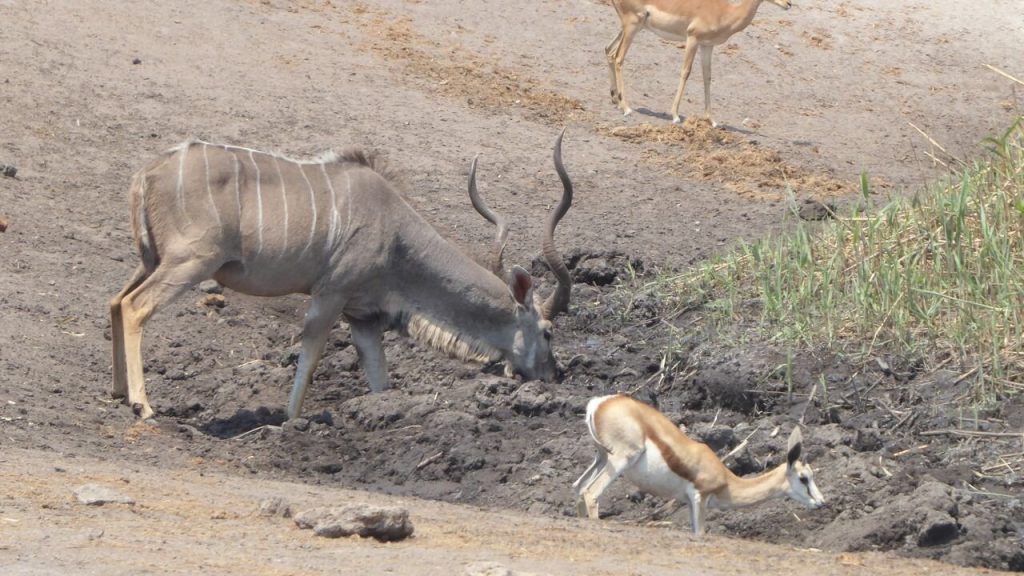
Bulls carry long spiralling horns that can reach well over a metre along the curve, twisting through two and a half turns in mature animals. Cows have no horns at all, which makes the sexes easy to tell apart at any distance.
The body is grey brown to reddish with narrow white vertical stripes down the flanks, a white chevron between the eyes and a fringe of hair along the throat and neck in bulls. Large rounded ears give them exceptional hearing.
They are big. Bulls stand around 1.4 metres at the shoulder and are among the largest antelope in Africa, second only to eland among species you will meet in Namibia.
The stripes work as camouflage in dappled bush and they work well. A standing kudu in mopane is very hard to see, which is why most sightings begin with movement or with the flash of a white tail as an animal turns away.
Behaviour, Diet and Jumping
Kudu are browsers rather than grazers, taking leaves, pods, fruit and occasionally grass, which is why they favour dense bush over open plain.
Cows and calves form small herds, with bulls solitary or in bachelor groups outside the rut. Cows carry for around nine months and produce a single calf. Bulls live roughly ten to twelve years.
The behaviour visitors remember is jumping. Kudu clear farm fences of two metres and more from a standing start, which is why farmers regard them as impossible to contain and why they turn up on roads unexpectedly. That jumping ability also makes them a genuine hazard for drivers.
They are most active in the early morning and late afternoon, lying up in cover through the heat of the day.
Kudu and Road Safety in Namibia
This is worth taking seriously and it belongs in any account of Namibian kudu.
Kudu are the single most dangerous animal to a driver in this country. They are large enough to come through a windscreen, they move at dusk and after dark, and their instinct when startled by headlights is to jump, frequently into the vehicle rather than away from it.
Unfenced roads through kudu country, which is much of central and northern Namibia, are where the risk sits. It is the main reason experienced hands here refuse to drive after sunset, and it is a rule worth adopting rather than testing.
During daylight, watch the verges rather than only the road ahead, and slow down where bush comes close to the tar.
Where to See Kudu in Namibia
Etosha. Common in the mopane and at bush fringed waterholes. Klein Namutoni, Goas and the wooded central section produce them regularly.
Central farmland and guest farms. The highest densities in Africa. Guest farms across the Khomas Hochland and Otjozondjupa hold kudu in numbers.
Waterberg and Erongo. Broken country with dense bush, which is ideal kudu habitat. Walking trails at Waterberg often produce them.
Damaraland riverbeds. Kudu work the riverine vegetation along the Huab and Aba Huab alongside desert elephant and giraffe.
Best Time to See Kudu
Year round, with the dry season from May to October easier because vegetation thins and animals come to water more predictably.
Early morning and late afternoon are when they move. Through the middle of the day they stand in shade and become close to invisible.
Look at waterholes fringed by bush rather than out on open plains. Kudu will cross open ground but they do not linger on it.
Kudu in Namibia Questions
Why do Namibian kudu get rabies?
Nobody is entirely certain, and the phenomenon occurs at this scale nowhere else in the species’ range. The virus appears to have originated from jackal, but the outbreaks are too large to be sustained by jackal bites alone. The current view is that kudu transmit it to each other without biting: group browsing on thorny acacia causes mouth lesions, infected animals shed high levels of virus in saliva, and kudu engage in mutual social licking.
How many kudu have died from rabies?
The first epidemic, running from the late nineteen seventies into the mid eighties, killed an estimated 50,000 animals, roughly 20 percent of the national population, with some accounts putting the figure higher. A second wave began at the start of this century, with around 2,500 dying on more than 81 farms in a single year. Rabies in Namibian kudu is now considered endemic and there is no sign of it abating.
Is it safe to be around kudu in Namibia?
In a vehicle, yes. The precaution worth taking is that rabid animals lose their normal wariness entirely, so a kudu showing no fear of people or vehicles, moving unsteadily or salivating heavily should be left alone and reported at the nearest lodge or gate. That is a genuine and Namibia specific concern rather than an abstract one.
Why are kudu dangerous to drivers?
They are large enough to come through a windscreen, they move at dusk and after dark, and their instinct when startled by headlights is to jump, often into the vehicle rather than away. They also clear two metre fences easily, so fencing does not keep them off roads. Kudu are the main reason experienced drivers in Namibia refuse to travel after sunset on unfenced roads.
Why does Namibia have so many kudu?
Habitat and the absence of predators. Kudu favour dense bush and broken country, which much of central and northern Namibia provides. Across large parts of the central farmland, lion, spotted hyena and African wild dog were removed by farming generations ago, and those three species account for a meaningful share of kudu kills elsewhere in Africa. Without that pressure, densities here are the highest on the continent.
Do female kudu have horns?
No. Only bulls carry the spiral horns, which reach well over a metre along the curve and twist through two and a half turns in mature animals. Cows are hornless, which makes sexing kudu straightforward at any distance, unlike oryx where both sexes carry horns and telling them apart takes practice.
Where is the best place to see kudu?
Anywhere with dense bush. In Etosha, the mopane woodland and bush fringed waterholes such as Klein Namutoni and Goas produce them regularly. Guest farms across the central highlands hold the highest densities in Africa. Waterberg and the Erongo mountains offer broken bush country that suits them, and walking trails there often produce sightings on foot.
Booking Your Namibia Trip
The safari companies and tour operators listed on this website put trips like this together for a living and know which camps, guides and routes actually deliver. We are an independent guide to Namibia; we do not book or sell tours ourselves.
When you are ready, arrange your safari, tour or holiday with one of the recognised operators listed here. Tell them your dates and what matters most, and a real person, not a form, will handle the itinerary, park bookings and logistics for you.