Flamingos of Namibia
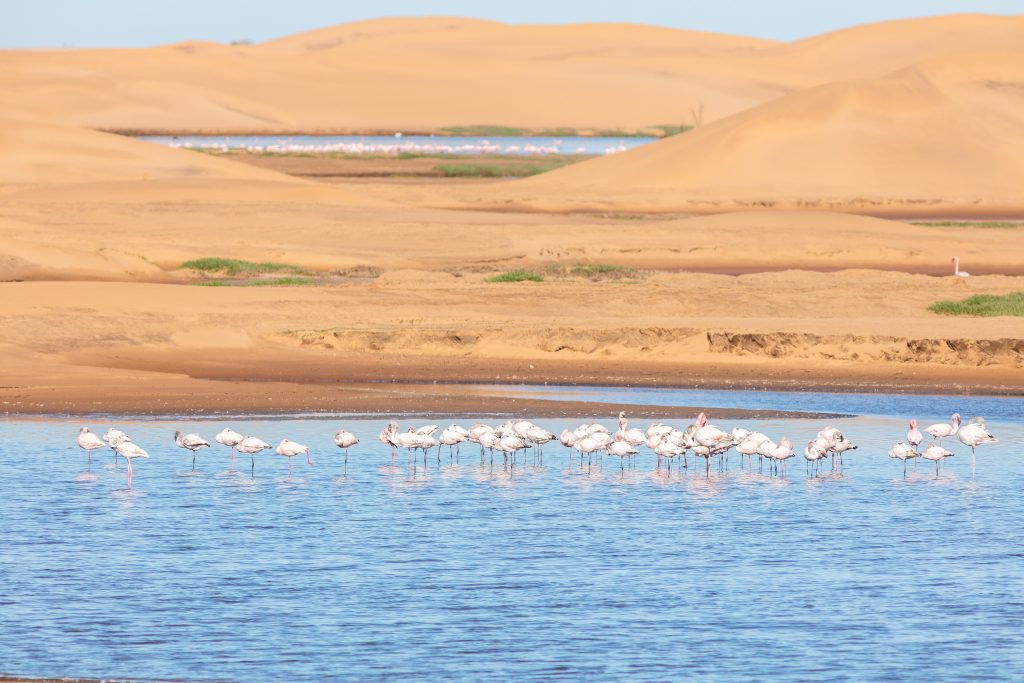
An estimated 80 percent of southern Africa’s flamingos spend part of the year in Namibia, moving between the coastal lagoons and the inland pans as rainfall dictates. Two species occur here, greater and lesser flamingo, and both breed on the Etosha Pan when it floods. Counts around Walvis Bay have reached roughly 86,000 birds.
Two Species, Two Feeding Depths
Namibia holds the greater flamingo, Phoenicopterus roseus, and the lesser flamingo, Phoeniconaias minor, and they share the same water without competing.
The greater is the taller of the two, with plumage that reads more white than pink, a light pink bill with a dark tip, and crimson wing feathers that contrast sharply against black primaries in flight. It feeds mainly on invertebrates: worms, small crustaceans and molluscs, along with some algae.
The lesser is smaller, standing under a metre, with deeper pink plumage and a dark maroon bill with a black tip. It feeds almost entirely on blue green algae, which is what gives it the stronger colour.
The elegant part is how they avoid competing. The lesser flamingo feeds close to the water surface while the greater, with its longer neck, feeds from the bottom up. Two species take different food at different depths in the same shallow water, which is why enormous mixed flocks work.
Both filter water through fine structures in the bill, feeding with the head upside down, and the pink colouring throughout comes from carotenoid pigments in what they eat rather than from anything in the bird itself.
Why Namibia Matters for Flamingos
The figure worth knowing is that around 80 percent of southern Africa’s flamingos spend time in Namibia during their intra African movements, which makes this one of the more important countries in the world for them.
That is a function of geography. Namibia offers two quite different resources: permanent, reliable saline habitat on the coast at Walvis Bay, Sandwich Harbour and the Swakopmund salt works, and enormous ephemeral breeding habitat inland on the Etosha Pan.
Movement between them is driven by rainfall. When the pans fill, birds head inland to breed. When the pans dry, they return to the coast, which functions as a permanent safety net supplying reliable food and saline water whatever the interior is doing.
The same pattern links Namibia to Botswana, since Sua Pan is the other major regional breeding site, and birds shift between the two according to where the rain has fallen.
Breeding on the Etosha Pan
The Etosha breeding events are among the great wildlife spectacles in Namibia and among the hardest to time.
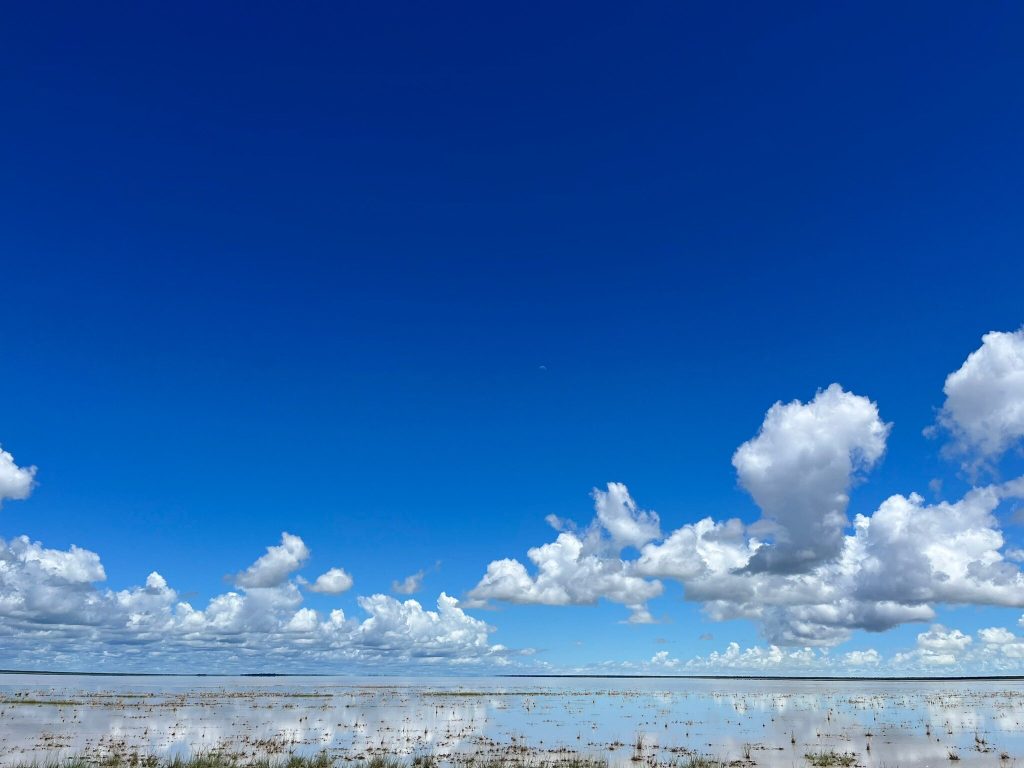
The pan floods when water arrives from Angola, running down into the northern edge, and in good years a dry white expanse becomes a shallow lake. Both species then arrive to breed, nesting on mud mounds built up above the water in the eastern part of the pan, near the Ekuma and Otjigombo areas in the north.
Numbers can be very large. Counts of up to 27,000 breeding pairs have been recorded on the pan, with up to 38,000 non breeding birds dispersed at Walvis Bay in the same period.
Flamingos choose total isolation to breed, nesting far out into the pan, well beyond the sight, sound and smell of predators, which also puts them beyond the reach of visitors. Breeding success varies enormously with how much water the pan holds and how long it lasts.
Do not plan an Etosha trip around the flamingo breeding. It depends on rain falling hundreds of kilometres away in Angola, it happens far out in the pan where you cannot go, and in poor years it does not happen at all. Treat flamingos on the pan as a rare piece of luck, and see them dependably at Walvis Bay instead.
The Courtship Display
The display that precedes breeding begins before the birds even leave the coast, and it is worth knowing about because you may see it at Walvis Bay.
The trigger is birds bunching tightly together with necks raised, then beginning to snap their heads sharply from side to side. That head flagging spreads through the flock, apparently contagiously, until large numbers are doing it in unison.
It progresses into a strutting march, the whole group moving together in dense formation, and culminates in a wing salute where thousands of birds stop simultaneously and extend their wings, showing the crimson and black underneath in one movement.
The function is synchronisation. Flamingos breed colonially and successfully only if the whole colony comes into condition at the same time, so the display works as a collective trigger that gets thousands of birds ready together.
The Flight to Etosha
How flamingos get from the coast to Etosha is a genuine piece of Namibian natural history and it is not the direct route you would expect.
Rather than flying northeast overland from Walvis Bay, the birds appear to head north up the coastline to a point roughly west of Etosha, then turn inland and fly straight for the pan. One theory holds that they follow the Ugab, Huab and Hoarusib river systems as navigational lines.
They fly at night and they fly low. Flamingos have been heard passing overhead in the dark along the Hoanib River, and low flight over that country has led to birds colliding with fibre optic cables strung across it.
Hearing a flock go over at night in the desert, well inland from any water, is one of the stranger experiences available in this country.
Where and When to See Flamingos
The coast is the dependable answer in every season.
Walvis Bay lagoon. The most reliable flamingo watching in Namibia, free and needing no boat or guide. Both species, close to the paved boardwalk. Best at first light.
Sandwich Harbour. South of Walvis Bay inside the national park, reached by guided 4×4 on the tide. Large numbers in a setting where dunes meet the sea.
Swakopmund salt works. The pink evaporation pans north of town, where the same algae that colours the water feeds the lesser flamingos.
Etosha Pan. Only when flooded, unpredictably, with breeding far out in the eastern pan. Fischer’s Pan near Namutoni is the accessible option in wet years.
Numbers on the coast build from around October through April as northern hemisphere migrants arrive and inland pans dry. The highest counts usually fall between December and March, and February is the month most often recommended for a solid ribbon of pink. During the Namibian winter many birds move inland, though several thousand non breeding individuals stay at the lagoon year round.
One count at Walvis Bay recorded over 43,000 greater flamingos in a single weekend, and the largest total recorded around the lagoon in three decades is roughly 86,000 birds across both species.
Threats and Conservation
Flamingos are long lived birds, reaching around 35 years in the wild and considerably more in captivity, and they do not begin breeding until five or six years old.
That longevity is a buffer. A run of poor breeding years matters far less to a bird that will get another twenty chances than it would to a short lived species, which is why conservation scientists have been relatively sanguine about drought years affecting Namibian breeding.
The concern is a sustained dry cycle rather than a single failed season. If the pans stop filling reliably over an extended period, breeding success falls away and the population eventually follows.
Beyond rainfall, the pressures are habitat disturbance at the coastal wetlands, development around Walvis Bay, and disturbance at breeding sites. The Walvis Bay lagoon and Sandwich Harbour are both Ramsar listed, which reflects how much of the regional population depends on them.
Photographing Flamingos
First light at the Walvis Bay boardwalk is the answer and it is not close.
The water is flattest before the wind rises, the birds feed nearest the path, and the light comes across the lagoon rather than into the lens. By mid morning the wind is up, the surface is broken and the flocks have moved further out.
For flight shots, look for the crimson and black underwing, which is invisible on a standing bird and is what makes a flying flamingo worth photographing. Groups take off and land constantly through the day.
A long lens helps but is not required at Walvis Bay, where birds feed within metres of the walkway. Keep back from feeding flocks rather than walking into them for a closer frame, since flushing birds costs them the energy they are there to accumulate.
Flamingos in Namibia Questions
Where is the best place to see flamingos in Namibia?
Walvis Bay lagoon, without qualification. A paved boardwalk runs several kilometres along the water, birds feed within metres of it, and there is no fee, permit or guide required. Sandwich Harbour to the south holds large numbers in a more dramatic setting but needs a guided 4×4 trip. The Swakopmund salt works are the third coastal option.
When are flamingo numbers highest?
Between about December and March, peaking as northern hemisphere migrants arrive and inland pans dry out. February is the month most often recommended for the densest concentrations. During the Namibian winter many birds move inland to breed, though several thousand non breeding individuals remain at the lagoon year round, so no month misses them entirely.
Can I see flamingos breeding at Etosha?
Rarely, and it cannot be planned. Breeding depends on the pan flooding, which depends on rain falling in Angola, and it happens far out in the eastern pan where visitors cannot go, deliberately isolated from predators. In good years up to 27,000 breeding pairs have been recorded. In poor years it does not happen at all. Treat it as luck rather than an itinerary item.
How do I tell greater from lesser flamingo?
Size and bill. The greater is taller, with plumage more white than pink and a light pink bill with a dark tip. The lesser stands under a metre, is a deeper pink, and has a dark maroon bill with a black tip. Feeding depth separates them too: lesser flamingos feed near the surface on algae, greaters feed from the bottom up on invertebrates, which is why they share water without competing.
Why are flamingos pink?
Carotenoid pigments in their food. Lesser flamingos feed almost entirely on blue green algae and are the deeper pink of the two as a result. Greater flamingos take more invertebrates including brine shrimp and are paler, with the strongest colour concentrated in the crimson wing feathers that show against black primaries in flight. The pigment comes from diet rather than from the bird.
How do flamingos get from the coast to Etosha?
Not by the direct route. They appear to fly north up the coastline to a point roughly west of Etosha, then turn inland and head straight for the pan, possibly following the Ugab, Huab and Hoarusib river systems. They travel at night and low, and have been heard passing overhead in the dark along the Hoanib. Low flight has led to collisions with fibre optic cables strung across that country.
How long do flamingos live?
Around 35 years in the wild, with captive birds recorded past 50. They do not begin breeding until five or six years old. That longevity acts as a buffer against poor breeding years, since a bird that fails one season has many more ahead. The genuine concern for Namibian flamingos is a sustained dry cycle rather than any single failed year.
Booking Your Namibia Trip
The safari companies and tour operators listed on this website put trips like this together for a living and know which camps, guides and routes actually deliver. We are an independent guide to Namibia; we do not book or sell tours ourselves.
When you are ready, arrange your safari, tour or holiday with one of the recognised operators listed here. Tell them your dates and what matters most, and a real person, not a form, will handle the itinerary, park bookings and logistics for you.