Duwisib Castle
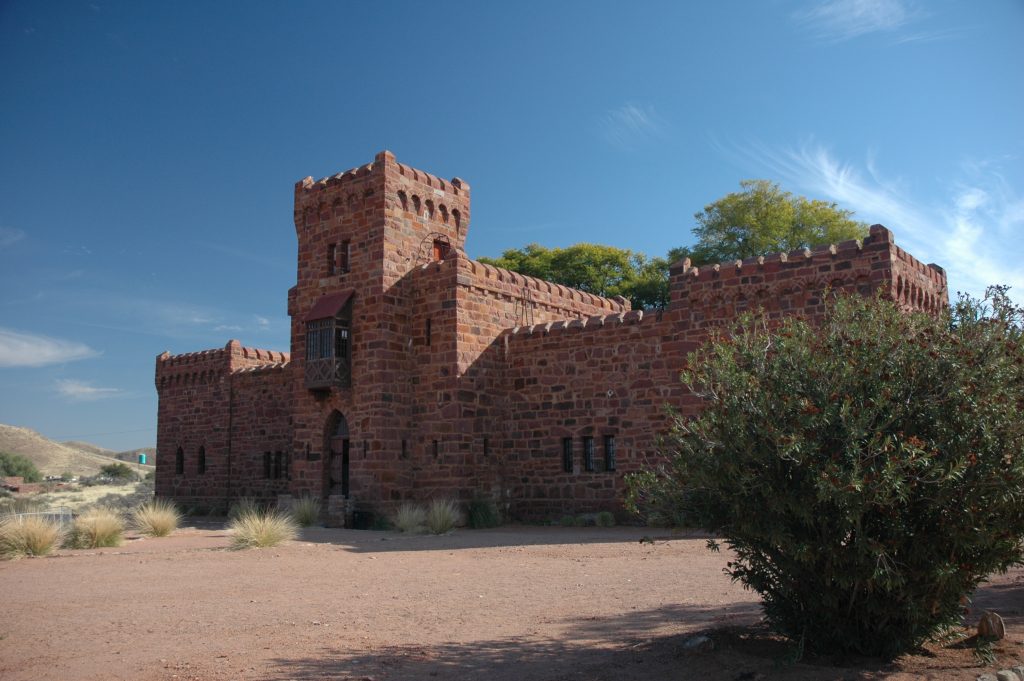
Duwisib Castle is a pseudo-medieval stone fortress standing alone in the semi-desert southwest of Maltahöhe, built by a German officer for his American wife and abandoned within six years when he was killed at the Somme. It has 22 rooms around a courtyard, materials shipped from Germany and landed at Lüderitz, and it now operates as a museum. The Namib’s wild horses may descend from his stud.
A Castle in the Wrong Place
Nothing about Duwisib makes sense at first sight, which is much of the appeal.
It sits in the hills of the southern Namib, surrounded by open plain and mountain, and looks like something lifted out of Saxony. Thick stone walls, crenellations, a large internal courtyard and heavy timber doors. It is not medieval in the slightest, having been built in the first decade of the twentieth century, and it was built to look as though it were.
The building runs to around 900 square metres with 22 rooms arranged around the courtyard. Most of the furnishings, fittings and building materials were shipped from Germany, landed at Lüderitz and hauled inland by ox wagon across a very long way of desert.
The only local material was the building stone itself, quarried a few kilometres from the site and moved by the same ox wagons.
Stonemasons were brought in from Italy, Sweden and Ireland, which for a building in this position took some doing.
Baron von Wolf
The man behind it was Hans Heinrich von Wolf, born in Dresden in 1873, a Saxon artillery officer who followed his father into the army and was posted to German South West Africa as a member of the Schutztruppe.
The Schutztruppe was the colonial army of the German Empire and its record here is not a comfortable one, since it was responsible for the genocide against the Herero and Nama. Germany issued an official apology many decades later. Any account of Duwisib sits inside that history rather than beside it.
After the Nama war von Wolf returned to Germany and in April 1907 married Jayta Humphreys, the stepdaughter of the American consul. The couple decided to settle in South West Africa and bought eight farms in the Maltahöhe area, eventually holding somewhere around 55,000 hectares.
Their plan was horse breeding. They ran a stud of English and Australian thoroughbreds, alongside mules, donkeys, pigs, chickens, several hundred Merino and Karakul sheep, around a hundred Hereford cattle and even Arabian dromedaries.
Within a few years the horse numbers had grown considerably and they were selling to the colonial police and the army. They were prevented from expanding their landholding further only because the authorities refused permission.
The Building of Duwisib
Von Wolf commissioned Wilhelm Sander, the most prominent architect working in the territory, who had already built several of the castle-style buildings in Windhoek.
Construction began around 1908 and the building was completed the following year. Sources differ slightly on the dates, with 1907, 1908 and 1909 all appearing depending on whether design, commencement or completion is being counted.
The cost is given as around 250,000 gold marks, a very substantial sum, funded by the couple’s means.
The result was intended to resemble the existing German forts in the territory, and it does, which raises a question the site does not entirely answer: whether this was a home dressed as a fortress or a fortress dressed as a home.
Give Duwisib longer than the drive-by most visitors make. The museum interior holds eighteenth and nineteenth century antiques, armour and paintings left behind when the family did not return, and the courtyard is the part that conveys what living here would have been like. Forty minutes inside is worth more than five minutes photographing the facade.
How It Ended
The dream lasted about six years.
In 1914 the couple sailed for Europe to buy more horses for the stud. War broke out while they were at sea and their ship was diverted, and von Wolf rejoined the German army on arrival.
He was killed in 1916, at the Somme by most accounts, in France. Jayta never returned to Africa.
The castle and the stud were left behind with most of the contents still inside. The property changed hands over the following decades, was bought by the state in the nineteen seventies, restored in 1991 and proclaimed a national monument.
It is now open to the public as a museum, with a coffee shop and camping on site.
The Wild Horses Connection
The most interesting loose end at Duwisib is what happened to the horses.
One long standing theory holds that the feral horses of the Namib, the population living near Garub on the plains west of Aus, descend from von Wolf’s abandoned stud. With nobody to manage them after the war, the animals dispersed and a wild population established itself.
It is one of several competing explanations. Others point to horses abandoned by the German Schutztruppe during the First World War campaign, or to animals from a South African military camp, and the truth may involve more than one source.
What is not disputed is that a feral horse population has survived in the desert near Aus for over a century, one of very few anywhere in the world living in genuinely arid conditions, and that its numbers have fallen sharply in recent years under drought and predation.
The connection makes Duwisib a better stop than it would otherwise be, since the castle and the horses can both be worked into a southern route.

Visiting the Castle
The castle is open daily through the day and day visitors are admitted between sunrise and sunset.
Inside, the museum holds a collection of eighteenth and nineteenth century antiques, armour and paintings, much of it original to the house. The courtyard is the part that gives the sense of the place, enclosed and cool after the glare outside.
There is a coffee shop and campsites on site, with further accommodation at the neighbouring guest farm, which has guest rooms, a bungalow, campsites and a pool with views to the surrounding mountains.
Allow an hour or so for the castle itself, or longer if you are staying the night, which suits travellers breaking the drive between Sossusvlei and the south.
Fitting Duwisib Into a Route
Duwisib sits on the D826 between Sesriem and Helmeringhausen, which puts it directly on the route south from Sossusvlei towards Lüderitz or Fish River Canyon.
That road is one of the more scenic in the country, and the castle is the natural break on it. Travellers going the other way, north from the south towards the dunes, reach it equally conveniently.
It combines well with Aus and the wild horses at Garub, given the connection, and with the drive on to Lüderitz and Kolmanskop.
Anyone taking the tar route south via the B1 will miss it entirely, which is worth knowing when planning the leg.
Best Time to Visit Duwisib
The castle is open year round and the building looks the same in any month.
April to September gives comfortable conditions on this route, with warm days and cold nights. Summer in the southern Namib is severe, and while the castle interior is cool, the drive and the camping are hard work between October and March.
Late afternoon light suits the stonework, and the mountains behind the castle catch colour at the ends of the day, which is when the photographs work.
Getting to Duwisib Castle
The castle lies roughly 70 kilometres southwest of Maltahöhe in the Hardap Region, on the D826 which runs between Sesriem and Helmeringhausen, around 25 kilometres from the junction with the D407 and C27.
Roads in are gravel and manageable in an ordinary car in dry conditions, though higher clearance is more comfortable as a rule on Namibian gravel.
From Sesriem allow a few hours. From Lüderitz or Fish River Canyon it sits on the northbound route. Fuel and supplies are at Maltahöhe or Helmeringhausen, both small, so fill up before you commit to the road.
Duwisib Castle Questions
Who built Duwisib Castle and why?
Hans Heinrich von Wolf, a Saxon artillery officer posted to German South West Africa with the Schutztruppe, built it for himself and his American wife Jayta Humphreys after they married in 1907. They settled in the Maltahöhe area, bought eight farms totalling around 55,000 hectares, and ran a stud of English and Australian thoroughbreds. Construction began around 1908 at a cost of some 250,000 gold marks.
Is Duwisib actually medieval?
No. It was built in the first decade of the twentieth century and made to look medieval, by the architect Wilhelm Sander who had already built several castle-style buildings in Windhoek. It was intended to resemble the German forts already standing in the territory. The effect is convincing enough that visitors regularly assume it is centuries older than it is.
What happened to the family?
They sailed for Europe in 1914 to buy more horses for the stud. War broke out while they were at sea, their ship was diverted, and von Wolf rejoined the German army on arrival. He was killed in 1916, at the Somme by most accounts. Jayta never returned to Africa, and the castle was left with most of its contents inside. The dream lasted about six years.
Are the Namib wild horses descended from Duwisib?
It is one of the long standing theories and it is not settled. The feral horses near Garub west of Aus may descend from von Wolf’s abandoned stud, or from horses left by the German Schutztruppe during the war, or from a South African military camp, and more than one source may be involved. What is certain is that a feral population has survived in that desert for over a century.
Can you stay at Duwisib Castle?
There are campsites on site alongside a coffee shop, and the neighbouring guest farm offers guest rooms, a bungalow, further campsites and a pool with views to the surrounding mountains. That makes it workable as an overnight break on the drive between Sossusvlei and the south rather than only as a stop.
Where were the building materials from?
Almost everything came from Germany, shipped in and landed at Lüderitz, then hauled inland by ox wagon across a very long stretch of desert. Stonemasons were brought from Italy, Sweden and Ireland. The only local material was the building stone itself, quarried a few kilometres from the site and moved by the same ox wagons.
Where is Duwisib and how do I get there?
Roughly 70 kilometres southwest of Maltahöhe in the Hardap Region, on the D826 between Sesriem and Helmeringhausen, about 25 kilometres from the D407 and C27 junction. The gravel roads in are manageable in an ordinary car when dry. Anyone taking the tar B1 south will miss it entirely, so the castle only appears on routes using the inland gravel roads.
Booking Your Namibia Trip
The safari companies and tour operators listed on this website put trips like this together for a living and know which camps, guides and routes actually deliver. We are an independent guide to Namibia; we do not book or sell tours ourselves.
When you are ready, arrange your safari, tour or holiday with one of the recognised operators listed here. Tell them your dates and what matters most, and a real person, not a form, will handle the itinerary, park bookings and logistics for you.