Desert Plants of Namibia
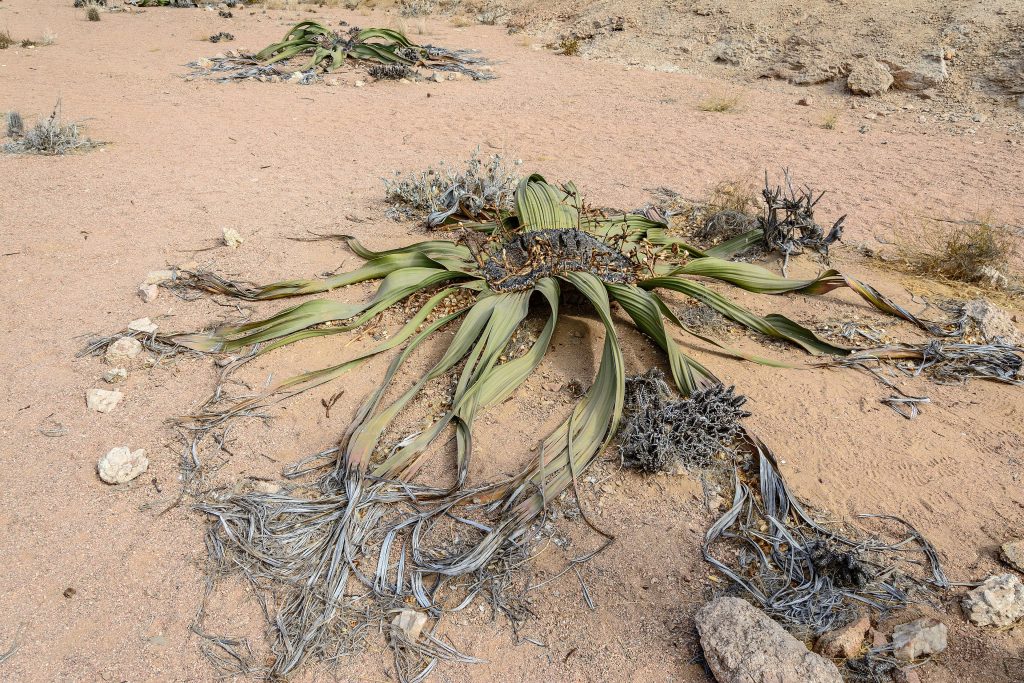
Namibia holds around 4,300 plant species and subspecies, of which more than a thousand occur exclusively or almost exclusively here. The welwitschia produces two leaves and keeps them for up to two thousand years. Quiver trees, nara melons, living stones and camel thorns each solve the water problem differently, and several are now declining as temperatures rise.
A Surprisingly Rich Flora
The figure catches people out. For a country with the lowest rainfall in sub Saharan Africa, around 4,300 plant species and subspecies is a substantial list, and more than a thousand of them are endemic or near-endemic.
The areas of highest diversity are not where you would guess. The Succulent Karoo in the southwest and the Kaokoveld in the northwest, both among the driest parts of the country, hold the richest floras. Extreme aridity has driven specialisation rather than emptiness.
What unites Namibian desert plants is that each has answered the same question differently: how to get water where there is almost none, and how to keep it once you have it.
Welwitschia: Two Leaves and Two Thousand Years
Welwitschia mirabilis is the plant Namibia is known for botanically, and everything about it is odd.
It is not a tree, a shrub or a succulent in the usual sense but sits on its own branch of the plant family tree, a survivor of a lineage otherwise long gone. It produces exactly two leaves in its lifetime and never replaces them. Those leaves keep growing, splitting and fraying at the ends, which is why a mature plant looks like a heap of torn leather straps rather than something with two of anything.
The numbers are worth stating. Leaves grow at roughly 8 to 15 centimetres a year, so a plant living a thousand years produces something in the order of 150 metres of leaf tissue. The broadest unbroken leaf recorded measured 179 centimetres across and over six metres long. Leaves average around 1.4 centimetres thick.
Estimated lifespans run from 500 to 1,000 years commonly, with the oldest specimens put well past 1,500 and possibly approaching 2,000. Some of these plants were alive when Rome fell.
They survive on fog. Most specimens grow within 80 kilometres of the coast inside the fog belt, in country that averages under 100 millimetres of rain a year and in some years receives none. Water is absorbed through the leaves themselves.
The leaves do more than feed the plant. Lying across the sand they shade the soil beneath, keeping it cool and moist where the surface can reach 65 degrees, and they hold firm in gale force wind, preventing erosion around the base.
The main viewing area is the Welwitschia plain about 50 kilometres east of Swakopmund, reached on the Welwitschia Drive, which needs a permit obtained beforehand rather than at a gate.
Do not walk on or between welwitschia plants and do not drive off the marked track to reach one. The root systems are shallow and wide, the plants grow a few centimetres a year, and a plant damaged today will not be replaced within any human timescale. The same applies to the lichen fields on the same gravel plains, which look like coloured stones and are alive.
Quiver Trees
The quiver tree is the plant most visitors photograph and it is not a tree either.
Aloidendron dichotomum, until recently classified as Aloe dichotoma, is an aloe that grows to tree size, reaching around 9 to 12 metres in favourable sites. The trunk is thick and covered in flaking golden bark with sharp edges, and the branches fork repeatedly in pairs, which is what dichotomum describes.
San hunters hollowed out the light fibrous branches to make quivers for arrows, which is where both the English name and the Afrikaans kokerboom come from.
They flower in winter, around June and July, sending up yellow blooms that draw sunbirds, weavers and baboons after the nectar.
The best known stand is the Quiver Tree Forest near Keetmanshoop, a natural grove of around 250 trees on dolerite that was declared a national monument. The oldest are two to three centuries old. Quiver trees also occur scattered across the south and along the escarpment.
Nara: The Dune Melon
The nara, Acanthosicyos horridus, is a spiny leafless perennial that grows in deep sand near the ephemeral rivers of the Namib, mostly west of the Kuiseb.
It has no leaves at all. Photosynthesis happens in the green thorny stems, which minimises water loss, and the root system runs deep enough to reach groundwater the surface never shows.
Its sprawling growth traps and stabilises sand, building hummocks that become small dunes in their own right, which makes it an engineer of the terrain as much as a resident of it.
The melon like fruit is the point for everything else. Juicy and edible inside a tough spiky shell, it supplies water and calories through the dry season, and oryx, porcupines and jackals dig them out during drought. The Topnaar community of the Kuiseb has harvested nara for a very long time and the plant remains central to their economy and food.
Living Stones and Other Succulents
The small succulents are the part of Namibian flora that rewards getting out of the vehicle.
Lithops, commonly called living stones, are tiny succulents that mimic the rocks around them so closely that finding one takes effort even when you know they are there. The camouflage protects them from herbivores. They store water captured during infrequent rain, go dormant in dry periods by retreating into themselves, and produce daisy like flowers when conditions allow.
Hoodia is a spiny succulent traditionally used by the San to suppress hunger on long hunting trips, which attracted pharmaceutical interest in appetite suppressants. Unregulated overharvesting followed and conservationists have pushed for the trade to be controlled.
The halfmens, Pachypodium namaquanum, is a single spine covered stem growing up to three metres with a rosette of leaves at the top, which from a distance suggests a person standing on a hillside. The name means half human.
Aloe erinacea, the spiny hedgehog, is endemic to southern Namibia. Succulent euphorbias occur widely, including the Damara milk bush of the Kunene gravel plains, which is highly toxic and which black rhino eat regardless.
Camel Thorn, Mopane and the Larger Trees
The camel thorn, Vachellia erioloba, formerly Acacia erioloba, is the defining tree of arid southern and western Namibia.
It grows along dry riverbeds where roots reach water far below the surface, which is why the riverbeds of Damaraland and Kaokoland support elephant and giraffe in country that otherwise could not. Its pods are a major food source for wildlife and livestock. Sociable weavers build their enormous communal nests in it.
The camel thorns at Deadvlei are the same species, dead for centuries and preserved rather than fossilised because the air is too dry for decay. The living ones at the base of Dune 45 nearby make the contrast plain.
Mopane dominates the woodland of the north, including much of Etosha, and its butterfly like leaves fold in the heat to reduce exposure. The moringa or fairy tale forest west of Okaukuejo is a stand of moringa trees unusual enough that Etosha guides point it out.
Bushman grass, several Stipagrostis species, sprouts and matures within weeks of good rain, which is how the plains green so fast after a storm.
Lichens: Not Plants, and Alive
The grey, orange and black crusts across the gravel plains of the Namib are not stones and not plants either.
Lichens are composites of a fungus with an alga or cyanobacterium, and more than a hundred species have been recorded in the Namib, forming what is among the more extensive lichen fields anywhere. They survive entirely on coastal fog.
Pour a little water on a dry lichen field and it changes colour and unfurls within minutes, which guides demonstrate on desert tours and which is one of the more memorable things you will see on this coast.
They grow extremely slowly and a single set of vehicle tracks through them remains visible for decades. That is the direct reason for the off road driving restrictions across Dorob National Park, and it is why staying on marked tracks matters more here than it sounds.

Climate Change and Declining Species
Two of Namibia’s best known desert plants are now under documented threat from rising temperatures.
Welwitschia mirabilis and the quiver tree have both been shown to be declining in response to a warming and drying climate. Quiver tree populations at the hotter northern end of their range are dying back while doing better further south, which is the signature of a species whose suitable range is shifting faster than it can follow.
Research has since extended the concern to succulent euphorbias in Namibia’s arid regions, finding that even highly specialised desert adapted plants are struggling on sandy desert soils as temperatures rise.
The problem is compounded by growth rate. A quiver tree takes decades to reach any size and a welwitschia grows a few centimetres a year. Neither can shift range or recover at the pace conditions are changing, which makes protected stands more valuable than they appear.
Where to See Namibia’s Desert Plants
Welwitschia plain. About 50 kilometres east of Swakopmund on the Welwitschia Drive, in the Namib section of Namib-Naukluft. Permit required in advance.
Quiver Tree Forest. Northeast of Keetmanshoop on the C17, a natural stand of around 250 trees on dolerite. Best at sunrise or sunset.
Nara hummocks. The Kuiseb delta and the dune country south of Walvis Bay, seen on Sandwich Harbour trips. Topnaar settlements are along the same route.
Lichen fields. Gravel plains north of Wlotzkasbaken and around Cape Cross on the C34 salt road. Guided living desert tours demonstrate them.
Best Time to See Desert Plants
Most of these plants look the same year round, which makes timing less critical than for wildlife.
Two exceptions matter. Quiver trees flower in June and July, which changes their appearance considerably and brings birds. And after good rain, roughly February to April, the gravel plains and dune valleys can flower briefly and Bushman grass greens the whole country within weeks.
Light matters more than season for photography. Quiver trees and welwitschia both work at the ends of the day and flatten out at midday. Winter, from May to September, gives comfortable conditions for walking on exposed plains with no shade.
Desert Plants of Namibia Questions
How old can a welwitschia get?
Commonly estimated at 500 to 1,000 years, with the oldest specimens put well past 1,500 and possibly approaching 2,000. Growth is a few centimetres a year, and leaves extend at roughly 8 to 15 centimetres annually, so a thousand year old plant has produced something like 150 metres of leaf tissue from the two leaves it started with and never replaced.
How do desert plants survive without rain?
Differently in each case. Welwitschia absorbs fog through its leaves. Nara has no leaves at all and photosynthesises through green stems, with roots reaching groundwater. Lithops store water from rare rain and go dormant between. Camel thorns send roots deep along riverbeds. Lichens run entirely on coastal fog. The common thread is that fog matters more than rain across much of the Namib.
Where can I see welwitschia?
The Welwitschia plain about 50 kilometres east of Swakopmund, on the Welwitschia Drive in the Namib section of Namib-Naukluft National Park. A permit is required and must be obtained from Ministry offices in Swakopmund or Windhoek beforehand, since there is no gate to pay at. Plants also occur through the Skeleton Coast and NamibRand areas.
Are quiver trees really trees?
No. Aloidendron dichotomum, until recently classified as Aloe dichotoma, is an aloe that grows to tree size, reaching 9 to 12 metres in good sites. San hunters hollowed the light fibrous branches to make arrow quivers, which gives both the English name and the Afrikaans kokerboom. They flower yellow in June and July.
Are Namibia’s desert plants threatened?
Several are. Welwitschia and quiver trees have both been shown to be declining because of a warming, drying climate, with quiver tree populations dying back at the hotter northern end of their range. Research has extended the concern to succulent euphorbias. Because these plants grow a few centimetres a year, they cannot shift range or recover at the pace conditions are changing.
What are lichen fields and why do they matter?
Composites of fungus with alga or cyanobacterium, not plants, forming grey and orange crusts across the Namib gravel plains. More than a hundred species occur here and they survive entirely on coastal fog. Water poured on a dry patch makes it unfurl and change colour within minutes. A single set of vehicle tracks stays visible for decades, which is why off road driving is restricted across Dorob National Park.
Can I take seeds or cuttings home?
No. Collecting plant material is prohibited, several of these species are protected, and overharvesting is already a documented problem with Hoodia. Beyond the legal position, most of these plants take decades to reach any size and removing material from wild populations that are already declining under climate pressure is straightforwardly damaging. Buy from cultivated stock at home instead.
Booking Your Namibia Trip
The safari companies and tour operators listed on this website put trips like this together for a living and know which camps, guides and routes actually deliver. We are an independent guide to Namibia; we do not book or sell tours ourselves.
When you are ready, arrange your safari, tour or holiday with one of the recognised operators listed here. Tell them your dates and what matters most, and a real person, not a form, will handle the itinerary, park bookings and logistics for you.