The Naukluft Mountains
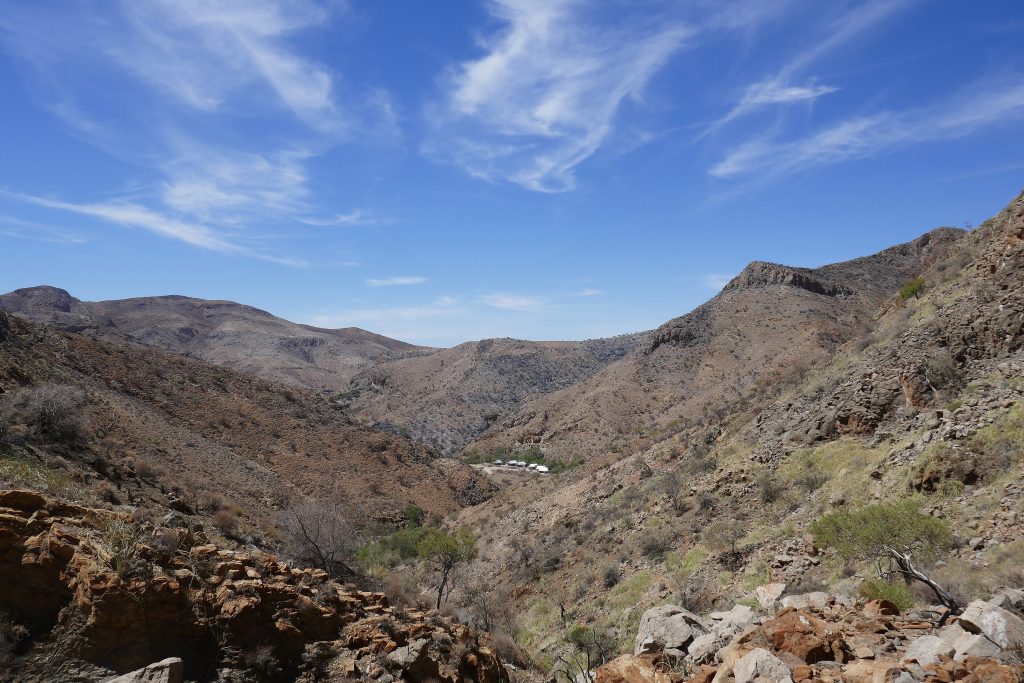
The Naukluft Mountains form the eastern section of Namib-Naukluft National Park, a craggy massif of gorges, plateaus and permanent springs holding pools deep enough to swim in. Two day trails run here without booking, the 10 kilometre Olive and the 17 kilometre Waterkloof. The 120 kilometre Naukluft Hiking Trail is widely considered the hardest in southern Africa.
Water in a Waterless Place
The Naukluft is the part of Namib-Naukluft that almost nobody visits, and the reason to go is the opposite of what the rest of the park offers.
Where the western section is dune sea and gravel plain, the Naukluft is mountain: narrow gorges leading up to high plateaus, gentle meadows ending abruptly in rock faces, and numerous springs feeding acacia groves and pools.
The springs are the point. The dolomite of the massif holds water and releases it steadily, which produces perennial pools in riverine valleys within an hour’s drive of country that receives almost no rain. Huge wild fig trees grow along them, along with karee and sweet thorn, and wild mint grows at the pools.
Standing in a gorge with your feet in cold running water, having driven through the Namib to get there, is a genuinely disorienting experience and it is what the Naukluft is for.
The Olive Trail
The Olive Trail is the shorter of the two day walks and the one most visitors do.
It runs around 10 kilometres and takes four to five hours, starting from a parking area on the main park road about three kilometres before the main camp. Follow the white painted footprints.
The walk begins with a steep ascent onto the plateau, which is the hard part and comes first, opening onto views across the plain within minutes. From there it descends into a narrowing gorge.
The section people remember is the chains. Where the gorge narrows and the route crosses a pool against a rock face, chains are fixed to the rock and you traverse hand over hand above the water. It is straightforward for anyone reasonably fit and comfortable with heights, and unnerving for anyone who is not.
Past the chains the trail opens out, meets a 4×4 track and follows it back to the parking area, around 45 minutes from the chains to the car.
Note that one official listing gives the Olive Trail as four kilometres, which conflicts with every other source and with walkers’ own timings. Plan for 10 kilometres and four to five hours.
Sign out at reception when you finish. Both day trails require you to sign in before starting and sign out on return, and walkers who forget trigger a search. Given the terrain and the fact that most parties are unguided, that system is the only thing standing between a twisted ankle in a gorge and a very long night.
The Waterkloof Trail
The Waterkloof is the longer day walk at 17 kilometres, taking six to eight hours, and it is the one for the pools.
It starts at the Naukluft campsite and is marked with yellow footprints. The route follows the Naukluft River before climbing through mountain streams, passing rock pools on a mostly gentle ascent, with five checkpoints along the way giving you a sense of progress.
The pools are the reason to do this one. Cold clear water big enough to swim in, ferns and flowers around them, huge fig trees, in country that looks incapable of supporting any of it. Water in most of the pools is drinkable and bottles can be refilled.
The descent afterwards is steep in places, running through a scenic gorge back to camp.
One warning from walkers: sections of the Waterkloof are harder to follow than the Olive and the markers are easy to lose. Walking it anticlockwise as far as the pools and returning the same way is a common and sensible variation.
The Eight Day Naukluft Hiking Trail
The full trail is a serious undertaking and is regularly described as the most demanding hiking trail in southern Africa.
It runs around 120 kilometres over about eight days with seven overnight stops, crossing the plateaus and gorges of the massif on foot with everything carried.
Because of the climate it is open only from the beginning of March to the end of October, and reservations are required. Parties carry all their own equipment and food.
Anyone considering it should treat the reputation seriously. This is not a scenic ramble with huts; it is a self supported mountain traverse in a place with no water beyond the springs and no easy exit points.
Booking is through Namibia Wildlife Resorts and the trail books out, so it needs planning well in advance rather than arranging on arrival.
The Naukluft 4×4 Trail
For travellers who would rather drive than walk, a 4×4 trail runs through the massif on tracks originally built by the farmers who worked this country.
It is a multi day route with overnight stops, taking you through terrain the day walks do not reach, and it requires booking and a properly capable vehicle.
The tracks are steep and rocky rather than sandy, which is a different challenge from Khaudum or the Kaokoland routes, and low range and clearance matter more than sand experience.
It is one of the better organised 4×4 trails in Namibia and considerably less well known than the driving in the northwest.
Wildlife of the Naukluft
The Naukluft was originally proclaimed to protect Hartmann’s mountain zebra and they remain what you look for.
Hartmann’s occupy the rocky slopes and plateaus, moving downhill in the late afternoon to drink and feed in the valleys and climbing back at first light. Walkers on the Olive Trail regularly meet groups of them on the plateau in the early morning.
Note that some sources describe the Naukluft as holding Cape mountain zebra. It does not. Cape mountain zebra occur only in South Africa, and Namibian mountain zebra are Hartmann’s, roughly 95 percent near-endemic to this country.
Klipspringer work the steeper rock, alongside kudu, oryx, springbok, baboon troops and dassies. Leopard are present and almost never seen.
Birding is good for raptors, with black eagle nesting on the perpendicular red cliffs and owls in the gorges. The Olive Trail plateau gives views onto black eagle nests.

Plants and the Resurrection Bush
The vegetation splits sharply between plateau and valley and it is worth noticing on the walks.
The plateaus carry sparse Karoo type vegetation: kapok bush, hardy euclea, occasional shepherd’s trees, buffalo thorn and mountain acacia. It looks dead for most of the year.
The riverine valleys are the opposite, with huge wild fig trees, karee, sweet thorn and wild mint around the perennial pools.
The plant worth watching for is the resurrection bush. Under dry conditions it shuts down almost entirely and appears lifeless. When rain falls the change is dramatic, with leaves opening and turning green within an hour. The leaves and twigs are used to make an aromatic tea.
Where to Stay in the Naukluft
Namibia Wildlife Resorts operates the Naukluft campsite, which is where both day trails begin and end.
It is a quiet, basic site with a small office and kiosk where you buy permits and can get a cold drink after a walk, with no allocated pitches so you choose on arrival. There is also a chalet option.
Several guest farms operate outside the park boundaries for travellers who would rather not camp, and they are the usual choice for anyone doing the day trails without a tent.
The campsite is the sensible base if you intend to walk, since both trails start from or near it and early starts matter in this heat.
Best Time to Visit the Naukluft
March to October is the window for the eight day trail, which does not operate outside those months for climatic reasons.
The two day trails can be done year round and do not require booking, though summer heat makes them hard work and early starts matter. Walkers advise starting the Olive Trail early in the morning rather than the afternoon.
Winter from May to September gives comfortable walking temperatures and cold nights. The pools are less inviting for swimming then, which is the trade off, since the warmer months are when people actually get in the water.
Carry at least four litres of water per person on either day trail, along with proper boots, a hat and sunscreen.
Getting to the Naukluft Mountains
The Naukluft section lies east of the dune sea, reached on the C14 and D854 from Sesriem or from Solitaire, and from Windhoek via Rehoboth and the gravel roads west.
It sits roughly between Sesriem and Windhoek, which makes it a possible stop on the drive to or from Sossusvlei for anyone willing to take the gravel rather than the direct route.
Access roads are gravel and manageable in an ordinary car in dry conditions. The 4×4 trail inside the massif is a separate proposition requiring a capable vehicle.
Fuel and supplies come from Solitaire or Maltahöhe, both small, so stock up before committing.
Naukluft Mountains Questions
What hiking is there in the Naukluft?
Two day trails needing no booking: the Olive Trail at around 10 kilometres taking four to five hours, and the Waterkloof at 17 kilometres taking six to eight. Both are well marked and can be walked unguided. The 120 kilometre Naukluft Hiking Trail over about eight days with seven overnight stops is regarded as the hardest in southern Africa and requires booking, running only from March to October.
What are the chains on the Olive Trail?
Where the gorge narrows and the route crosses a pool against a rock face, chains are fixed to the rock and you traverse hand over hand above the water. It is straightforward for anyone reasonably fit and comfortable with heights, and unnerving for anyone who is not. Past the chains the trail opens out and meets a 4×4 track back to the parking area.
Can you swim in the Naukluft?
Yes, which is unusual in this part of Namibia. The Waterkloof Trail passes rock pools fed by perennial springs, cold and clear and big enough to swim in, surrounded by ferns and huge fig trees. Water in most of them is drinkable and bottles can be refilled. The warmer months are when people actually get in, since winter makes them bracing.
How long is the Olive Trail really?
Around 10 kilometres, taking four to five hours. One official listing gives it as four kilometres, which conflicts with every other source and with walkers’ own recorded timings, so plan for the longer figure. Start early in the morning rather than the afternoon, since the heat builds and rental agreements usually prohibit driving after dark.
Do I need to book the day trails?
No, the Olive and Waterkloof trails need no advance booking and can be walked unguided. You do need to sign in before starting and sign out at reception on return, and walkers who forget trigger a search. The eight day Naukluft Hiking Trail is entirely different and requires reservation well in advance through Namibia Wildlife Resorts.
What zebra live in the Naukluft?
Hartmann’s mountain zebra, which the area was originally proclaimed to protect. Some sources describe Cape mountain zebra here, which is wrong: that subspecies occurs only in South Africa. Hartmann’s are roughly 95 percent near-endemic to Namibia. They work the rocky slopes and descend to the valleys in late afternoon, and walkers meet them on the plateau in early morning.
Where does the Naukluft fit on a route?
It sits east of the dune sea between Sesriem and Windhoek, so it works as a stop on the drive to or from Sossusvlei for anyone taking the gravel roads rather than the direct route. One or two nights covers both day trails. Almost nobody visits it, which is much of the appeal for travellers who have already seen the dunes.
Booking Your Namibia Trip
The safari companies and tour operators listed on this website put trips like this together for a living and know which camps, guides and routes actually deliver. We are an independent guide to Namibia; we do not book or sell tours ourselves.
When you are ready, arrange your safari, tour or holiday with one of the recognised operators listed here. Tell them your dates and what matters most, and a real person, not a form, will handle the itinerary, park bookings and logistics for you.