Pelicans of Namibia
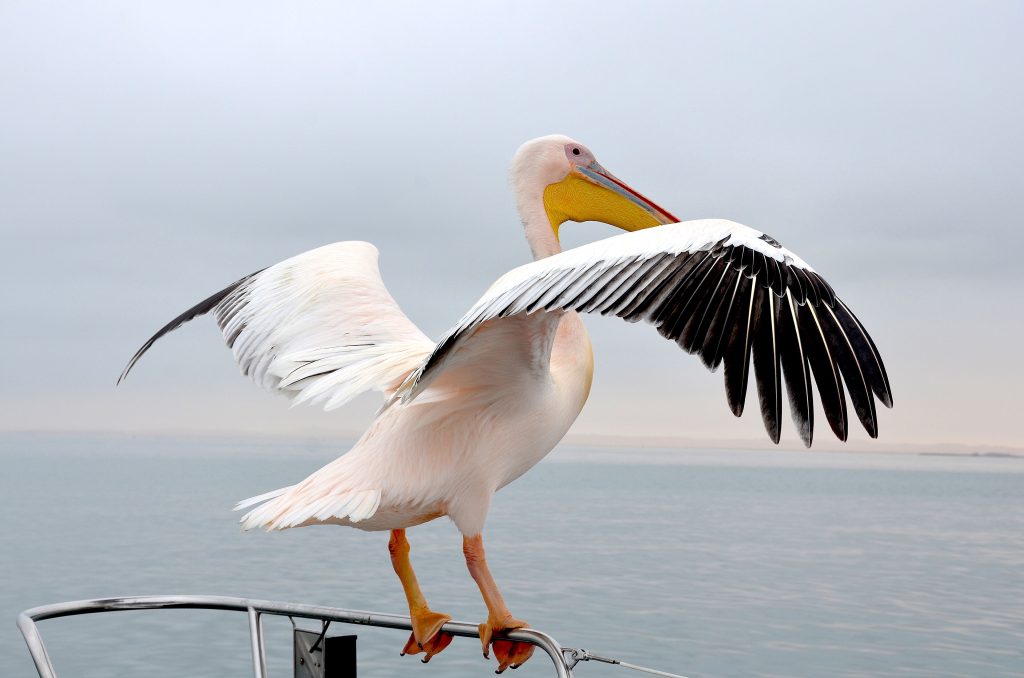
Great white pelicans are the birds that land on the deck of your boat at Walvis Bay, with a wingspan reaching around three metres. Namibia holds two species, the great white on the coast and the smaller pink backed in the northern wetlands. Pelican Point, the sand spit enclosing Walvis Bay, is named after them.
Two Pelican Species in Namibia
The great white pelican, Pelecanus onocrotalus, is the one nearly every visitor sees. It is among the largest flying birds in the world, with a wingspan commonly given between 2.2 and 3.6 metres, white plumage tinged pink in breeding condition, and a long yellow pink bill with the enormous throat pouch beneath it.
It occupies the coastal wetlands: the Walvis Bay lagoon, Sandwich Harbour, the Swakopmund salt works and Pelican Point itself. Numbers on the lagoon run into the hundreds regularly.
The pink backed pelican, Pelecanus rufescens, is considerably smaller and greyer with a faint pink wash on the back, and it occurs in the northern wetlands: the Okavango, the Kwando, the Zambezi and the floodplains of the Zambezi Region. Most visitors never see one because most visitors do not go there.
The two do not usually overlap in Namibia, which makes identification a matter of geography as much as appearance.
Why They Land on Boats
The behaviour visitors remember from a Walvis Bay cruise is a pelican landing on the deck, and it is worth knowing what is actually happening.
These birds have learned that boats mean fish. Operators feed them, which is why individual pelicans follow specific vessels, land on the rail or the roof and take fish from a hand. The same applies to the Cape fur seals that climb aboard.
It is habituation rather than tameness. These are wild birds that have worked out a food source and behave accordingly, and they leave the moment the fish stops.
Whether feeding wildlife for tourism is a good idea is a fair question. It concentrates birds around boats, it may alter natural foraging, and it makes for an experience visitors consistently rate as the highlight of their coastal day. Both things are true and worth knowing before you book.
If a pelican lands near you on a boat, stay still and keep your hands down rather than reaching. That bill is around 40 centimetres long with a hooked tip and the bird is heavier than it looks in flight. Let the crew manage the feeding, and photograph from where you are sitting rather than standing up and crowding it.
How Pelicans Fish
The pouch is the point and it is not a storage container, which is the common misconception.
The throat pouch works as a net and a strainer. A pelican plunges its bill into the water, the pouch expands to scoop in a large volume of water along with any fish, and the bird then tilts the bill down to drain the water out before swallowing. The pouch can hold considerably more than the stomach.
Great white pelicans frequently fish cooperatively, which is genuinely worth watching. A group forms a line or a horseshoe on the water, swims forward together beating their wings, and drives fish into shallower water where all of them can scoop at once. It is coordinated rather than accidental.
They are surface feeders rather than divers. Brown pelicans elsewhere in the world plunge from height; the great white does not, working instead from the surface with the head and neck.
Their diet is fish, taken in substantial quantity, and along this coast that means the same sardines, anchovies and other small fish that the whole Benguela system runs on.
Pelican Point and the Walvis Bay Lagoon
The sand spit enclosing Walvis Bay is called Pelican Point for good reason.
Great white pelicans work the deeper channels of the lagoon while flamingos take the shallow flats, which is one more example of species dividing the same wetland by depth. They roost on the spit, on the artificial guano platforms in the bay and on the salt works.
The lagoon holds tens of thousands of wetland birds across more than 150 species and is Ramsar listed. Pelicans are among the most conspicuous of them, both because of size and because they fly in formation low over the water, which is one of the better sights on this coast.
The boardwalk along the lagoon edge gives close views on foot without a boat, at no cost. Catamaran cruises out to Pelican Point put the birds on the deck beside you.
Breeding and Movement
Great white pelicans breed colonially on islands and remote flats, and in Namibia the breeding sites are away from the areas most visitors reach.
They nest on the ground in dense colonies, and the birds are sensitive to disturbance at the nest, which is one reason several coastal areas are closed to vehicles. A disturbed colony can abandon.
Chicks are naked at hatching and take a considerable time to fledge, during which the adults commute substantial distances to fish. Great white pelicans will travel a long way from a colony to a feeding ground and back, and formations of birds crossing high above the coast are usually doing exactly that.
The birds move between the coastal wetlands seasonally and in response to conditions, so numbers on the Walvis Bay lagoon fluctuate through the year without the population going anywhere.
Threats and Conservation
Great white pelicans are not globally threatened, which does not make the Namibian population secure.
The pressures on this coast are the same ones affecting the penguins and cormorants: competition with the commercial fishery for the fish stocks both depend on, disturbance at breeding and roosting sites, and development around the Walvis Bay wetland.
Sardine stocks along this coast collapsed after heavy fishing last century and have not recovered to former levels, which has consequences through the whole seabird community.
The Walvis Bay lagoon and Sandwich Harbour are both Ramsar listed, which reflects how much of the regional bird population depends on them, and vehicle restrictions across Dorob National Park exist partly to protect ground nesting and roosting birds.
Telling Pelicans Apart from Other Large Birds
At distance on the water, a pelican can be confused with a swan, a large gull or a cormorant group, and the bill settles it every time.
Great white pelican: very large, white, long yellow pink bill with a pendulous pouch, black flight feathers visible when the wings open. On the water it sits high with the bill resting along the neck.
Flamingos are the other tall white and pink bird here and they are unmistakable once seen, with the long thin legs, the bent bill and the feeding posture with the head upside down in the water. Pelicans have short legs and float.
In flight, pelicans hold the head drawn back onto the shoulders with the bill resting along the front, which is the diagnostic feature at any distance. Flamingos and storks fly with the neck extended.
Where to See Pelicans in Namibia
Walvis Bay lagoon. On the water and along the boardwalk, free and needing no booking. Great whites work the deeper channels while flamingos take the shallows.
Pelican Point cruises. Catamaran trips from the Walvis Bay waterfront, where birds land on the deck. The close contact most visitors remember.
Sandwich Harbour. Large numbers on the lagoon south of Walvis Bay inside the national park, reached by guided 4×4 on the tide.
Zambezi Region. Pink backed pelicans on the Okavango, Kwando and Zambezi floodplains. A different species and one very few visitors see.
Best Time to See Pelicans
Great white pelicans are present on the Walvis Bay lagoon year round, so no season misses them.
Numbers on the coast are highest through the summer months from around November to March, alongside the flamingo peak, as birds concentrate on the coastal wetlands.
Morning is the operative window, as with everything on this coast. The lagoon is calmest before the wind rises, birds feed closest to the boardwalk, and boat trips run in the morning slot for the same reason.
For pink backed pelicans in the northeast, the dry months from June to October give the best access, since the rains flood the roads.
Pelicans of Namibia Questions
Which pelican species live in Namibia?
Two. The great white pelican occupies the coastal wetlands including the Walvis Bay lagoon, Sandwich Harbour and Pelican Point, and is the one nearly every visitor sees. The pink backed pelican is smaller and greyer and occurs in the northern wetlands of the Zambezi Region on the Okavango, Kwando and Zambezi. The two rarely overlap here, so geography usually settles identification.
Why do pelicans land on the tour boats?
Because operators feed them. Individual birds have learned that specific boats mean fish and follow them, landing on the rail or roof and taking fish from a hand. It is habituation rather than tameness, and they leave when the food stops. The same applies to the Cape fur seals that climb aboard. Whether feeding wildlife for tourism is good practice is a reasonable question to ask your operator.
What is the pelican’s pouch for?
Fishing, not storage, which is the common misconception. The pouch works as a net and a strainer. The bird plunges its bill in, the pouch expands to scoop a large volume of water and any fish with it, and the bird then tilts the bill down to drain the water before swallowing. The pouch holds considerably more than the stomach does.
Do pelicans hunt together?
Great white pelicans frequently do, and it is worth watching. A group forms a line or horseshoe on the water, swims forward together beating their wings, and drives fish into shallower water where all of them can scoop at once. It is coordinated rather than incidental. They are surface feeders and do not plunge from height the way brown pelicans elsewhere do.
How big are great white pelicans?
Among the largest flying birds in the world, with wingspans commonly given between 2.2 and 3.6 metres and a bill around 40 centimetres long with a hooked tip. They are heavier than they look in flight. If one lands near you on a boat, stay seated with your hands down and let the crew handle it rather than reaching towards the bird.
Where is the best place to see pelicans in Namibia?
The Walvis Bay lagoon, where they work the deeper channels and can be watched free from the paved boardwalk with no booking. Catamaran cruises out to Pelican Point put birds on the deck beside you, which is what most visitors remember. Sandwich Harbour holds large numbers in a more dramatic setting but needs a guided 4×4 trip on the tide.
Are pelicans threatened in Namibia?
Great white pelicans are not globally threatened, though the Namibian coastal population faces the same pressures as the penguins and cormorants: competition with the commercial fishery for the fish stocks all of them depend on, disturbance at breeding and roosting sites, and development around the Walvis Bay wetland. Sardine stocks collapsed last century and have not recovered to former levels.
Booking Your Namibia Trip
The safari companies and tour operators listed on this website put trips like this together for a living and know which camps, guides and routes actually deliver. We are an independent guide to Namibia; we do not book or sell tours ourselves.
When you are ready, arrange your safari, tour or holiday with one of the recognised operators listed here. Tell them your dates and what matters most, and a real person, not a form, will handle the itinerary, park bookings and logistics for you.